This book and I didn’t totally click, and I’m not sure I can articulate why. The back cover describes it as “part novel and part memoir,” and its 100 short sections tell the story of a life: childhood, marriage, parenting, travel. It’s set mostly in Israel, with bits elsewhere (primarily Japan), and it sometimes reads as a straight narrative but not always. At its best moments it’s beautiful or funny or both, and the narrative is often satisfyingly writerly/self-aware, like this: “The kerosene lamps were lit (I recall) in the Egyptian prisoners’ tents. At eleven, all at once, all the lights went out (and here the temptation grows very great to write something that ends with “stars”)” [9]. There are also a number of strange and surreal moments, some of which were great but others of which just left me sort of befuddled. (One that worked: a story about huge amounts of porridge boiling over out of the university cafeteria: so much that exams were canceled, so much that it had to be removed with snowplows. One that just left me befuddled: a brief mention of Srurr, the owner of a shoe store, who “came out of his house and didn’t return because the colors on his body were erased (as though by divine white-out) one by one from the bottom up” [20].) And much of the start of the book felt like a slog—maybe I was just getting used to Hoffmann’s style, or maybe it’s that the sections focused on childhood are too distant-seeming, but it was slow going for a while, though things picked up when the narrator took his first trip to Japan, at which point we get lovely bits like this:
“We sat (the three of us) on the straw floor and, with wooden chopsticks, brought the noodles up from the soup bowl. Hot vapor enveloped us and, for a few moments, we lost one another” [46].
Or this: “Fog covers the city of Kyoto entirely, and the booksellers take their wares from the sidewalk into the stores, since the pedestrians walk by as thought they were blind and knock over the books of philosophy, economics, and history” [53].
Or this:
The girl Sivan speaks Japanese fluently but while all the children draw the rock garden at the Ryoanji temple with complete accuracy, she makes some of the rocks bigger and others smaller and adds rocks of her own. The art teacher (who most likely has not heard of impressionism) calls on her to “respect reality.”
We (that is, I) respect reality deeply. [50]
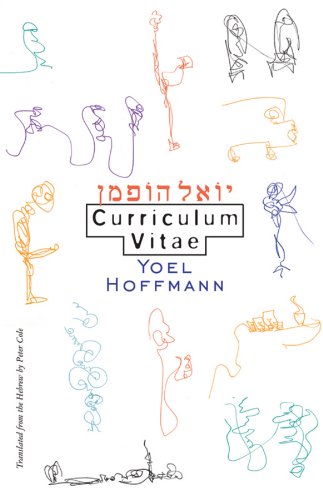
The book is illustrated with drawings by Hoffmann, most of which weren’t that exciting to me: they’re lines and squiggles, loose forms—see the cover for some examples, though inside the book they’re not in color, and are coupled with captions from the text. The best one in the whole book, for me, is the one that goes with the “We (that is, I) respect reality deeply” sentence above:—just an arced line. I love it.
Note: this book doesn’t have page numbers, which kept weirding me out at the start. The numbers given after the quotations are the numbers of the sections from which those lines came.
Also: if you’re interested in reading a review by someone who liked this book more than I did, see Robert Leiter’s review of this book here.
Leave a Reply