I’ve been living in NYC for twelve-ish years now: I came for college and didn’t leave. (During college I stayed in the city in the summers, mostly, though I did go to my mom’s house in Georgia for a stretch of one summer, and spent most of another summer living in Cambridge, MA.) I’ve finished the Great Saunter five times, and, over the course of several years, walked over 325 miles throughout the five boroughs on a number of these walks with Matt Green and others. In college I took Kenneth Jackson’s History of the City of New York class, and did that class’s all night bike ride on my ex-boyfriend’s sister’s bike, because I didn’t have one of my own yet. I definitely don’t have as many historical facts and dates and names in my head as some people I know, but I’m curious about the city, and reasonably well-informed about its history. So when I started reading Lost New York, I wasn’t sure how much I would like it, or how interesting it would be, or how much of it I would already know. As it turned out, it was a mix of the familiar and new, but a pretty satisfying book to dip in and out of over the course of several evenings.
In the book, Marcia Reiss covers various “lost” buildings and places throughout the city. It’s organized chronologically, by the date that a building/place was demolished/burned/closed down/otherwise taken out of commission, from the 1890s to the 2000s. Each entry starts with the building/place name, how it was lost, and the date of its demise; most buildings/places get two-page spreads, one of which is a full-page black-and-white image, though some places get a bit more (Steeplechase Park, on Coney Island, gets four pages). Even for the ones I knew about, there was often some new piece of knowledge in the photos or the text: like, I knew that the current building of the Metropolitan Museum of Art is a remodeled and expanded version of the original, but I didn’t realize, or didn’t remember, that there was a big disagreement over the style of building that was appropriate for a museum in a park, with Calvert Vaux and others arguing that a Neoclassical structure (which is what the museum ended up as) wasn’t suited to the park’s “natural” setting. Some pieces were more interesting to me than others: there are numerous 5th Avenue Gilded Age mansions that all sort of ran together, and I don’t really care about the old Yankee Stadium or Ebbets Field. But I loved all the parts about Coney Island, like the spread about the elephant-shaped hotel that burned down in 1896, or the section on Luna Park, in which I learned about the “Candy Delicatessen,” where “vegetables, liver pudding, blood pudding, and a long list of other childhood torments were all made of candy” (78). (See this page for more on that, including a picture that I wish were bigger/crisper.)
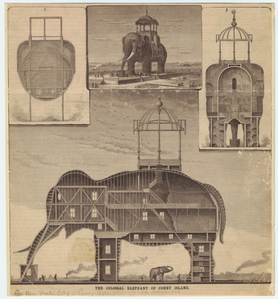
(Elephant hotel picture courtesy of the New York Public Library Digital Gallery)
Speaking of pictures, the photos and illustrations in Lost New York are clearly a big part of its appeal. I love the little details that are visible in the full-page images, the sense you get of the texture of life in the city at whatever time the picture was taken. In one photo of the aforementioned Elephantine Colossus, you can see painted signs for a “Historic Sioux Indian War Village,” and for “Drummond’s Cottages, Furnished Rooms,” and for “Andrew Holzer’s Stables,” which are related to some beer company whose name is partially obscured. In a picture of Dreamland, another Coney Island amusement park, there’s the boardwalk and a faux-Venetian lagoon, men in straw hats and women with parasols, striped awnings and a sign for “Mowgli the Missing Link,” and a big sign for “Fighting the Flames, an attraction in which there were “scores of firefighters armed with steam pumpers and hook-and-ladder trucks climbing over a six-story building to put out a sham fire while men and women leapt from the roof into nets” (18). In a picture of Herald Square there are signs for “Offices and lofts to let,” and for “Lucio’s Pearls,” which must be synthetic or otherwise not-quite-real, since the sign says they “Defy Detection.” There’s a sign for “Chiropody, Hair Dressing, & Facial Massage,” and there’s the Hotel Normandie in the background, advertising itself as “Absolutely Fireproof” (32).
Other highlights of the book for me: 1) The two pages about the old Central Park Children’s Zoo (in operation from 1961 to 1997): I don’t think I’d ever seen photos of it before, complete with Whaleamena, the fiberglass whale whose mouth you could walk into, but I remember reading about it as a kid in a Golden book called A Visit to the Children’s Zoo, which I got as a hand-me-down from a cousin who was born in the ’60s. (See someone else’s picture of part of that Golden book here.) 2) The section on “Floating bathhouses and Play Piers for the Poor,” which were “discontinued circa 1939”: “After the Civil War, health advocates urged the creation of floating bathhouses, a luxury for tenement dwellers who did not have running water in their apartments. The first bathhouses were placed in the Hudson and East rivers in 1870, and by 1890, fifteen were in operation” (65). Whoa, suddenly the Floating Pool Lady has a whole new context (which, clearly, its creators are aware of – see the “History” page of their site for pics and text about the floating bathhouses). I had no idea!


Leave a Reply to megan Cancel reply